

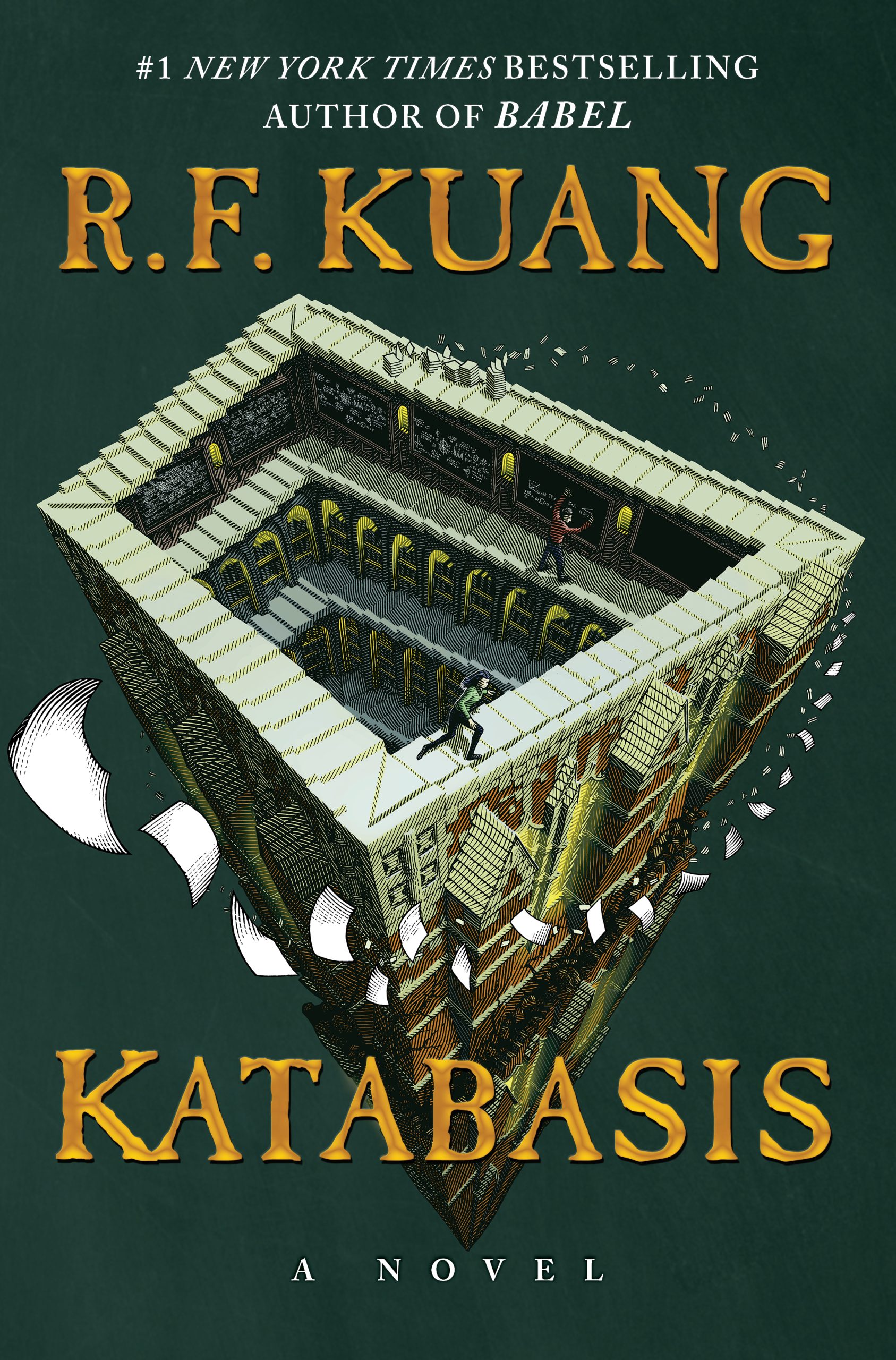
By R.F. Kuang
“Katabasis, noun, Ancient Greek: The story of a hero’s descent to the underworld. Alice Law has only ever had one goal: to become one of the brightest minds in the field of Magick. She has sacrificed everything to make that a reality: her pride, her health, her love life, and most definitely her sanity. All to work with Professor Jacob Grimes at Cambridge, the greatest magician in the world. That is, until he dies in a magical accident that could possibly be her fault. Grimes is now in Hell, and she’s going in after him. Because his recommendation could hold her very future in his now incorporeal hands and even death is not going to stop the pursuit of her dreams… Nor will the fact that her rival, Peter Murdoch, has come to the very same conclusion. With nothing but the tales of Orpheus and Dante to guide them, enough chalk to draw the Pentagrams necessary for their spells, and the burning desire to make all the academic trauma mean anything, they set off across Hell to save a man they don’t even like. But Hell is not like the storybooks say, Magick isn’t always the answer, and there’s something in Alice and Peter’s past that could forge them into the perfect allies…or lead to their doom.” – Goodreads
I have so much to say about this book and nothing at all. Now I understand why there’s so much controversy and differing opinions in the book world – R.F. Kuang has a very unique writing style and made some interesting choices throughout the storyline. Katabasis was at once a thoughtful character study and an literary exploration of every culture’s hell. In Alice Law’s katabasis through the underworld, she descends also into the depths of herself and uncovers the extreme highs and lows of human nature. It’s a deep and depressing look at academia, especially women in academia, and the costs of relentless ambition in general. In my eyes, Katabasis pulled off an underworld story in true pagan fashion – questioning the meaning of life, the satisfaction of ambition, and spirituality only to end up just this far away from a revelation of Christ.
I went into this one expecting a mythological epic – constant action and excitement. After all, most underworld stories involve one evil deity and demon after another. Instead, Kuang took a more character-focused route. Most of the excitement and action scenes serve to teach the reader more about Alice, Peter, or the underworld itself. Rather than a climax, the book builds to more of a volta of sorts, realizations that quickly wrap up Alice’s character arc. I really enjoyed it and felt attached to Alice quickly, so I was plenty invested in her personal arc. On the other hand, I know other people found Alice to be a walking “not-like-other-girls” trope and thought her character development all happened at once. I disagree, and I think that was part of the point. Alice seems pretty aware of the consequences of her own ambition, as well as the pain and hunger that comes with her borderline-eating-disorder ascetic lifestyle, but she sees her goals as worthy as all that. To her, the meaning of life is success. If success takes putting up with the humiliating ways women are treated in academia, Alice will accept it. She doesn’t idolize Grimes because she’s weak and unable to “fight back against the patriarchy,” but because she idolizes what he represents. She was such an interesting character, and her choices and feelings drove the plot. As her attitude got darker, so too did the plot.
I rate this category low not because I don’t like Kuang’s academic style, but because I will admit that it was a lot of telling rather than showing. The author’s stylistic choices led to this – having to explain academic concepts a lot and build out a background on Hell that readers might not already have – but some passages were harder to get through because of the constant musing on logical or philosophical concepts. I also would’ve liked to see more linguistic elements. Alice is supposed to be studying linguistics as a magician, but we didn’t see much “magic” done with that topic.
Alice was one of the most interesting characters I’ve seen in a while. Her flaws are not there just to round out a downloadable-character-outline sheet. She actually has very few redeeming qualities. Despite this, you are still rooting for her. Her ambition – the reason she has so many destructive habits – keeps the reader in awe of the lengths she’ll go for success… even to the point of journeying to Hell. I found Alice a valuable archetype for those who don’t understand their purpose in life. As a Christian, I know that no matter what I do on this earth, my actions should glorify God. If I were to become an academic like Alice, I would similarly strive for excellence for the sake of God, but I would have a much more balanced life knowing that my value does not reside in success alone, but what I can give to others and God through that success. As I said earlier, it was so obvious to me reading this book exactly what each character was missing in their life and it wasn’t just “enjoy life to the fullest” or something like that.
As for Peter, I thought his character was a little less fleshed out. Much of the character’s backstories were outlined through the use of flashbacks (this book is fullll of flashbacks, which both slows it down and speeds it up at certain points), but again, this leads to a feeling of being told rather than shown. Peter’s backstory especially was described like a linear bedtime story – not much literary subtlety there. Otherwise, he was an interesting foil for Alice. Though he retained much of the same flaws as her, he also had a lot of differences that made them a fun pair. There’s a lot less romance than I was led to believe (forgivable because of the state of book marketing today), so it was a very sweet and smut-less story.
I’m giving this five stars, not because it was a perfect book because it had that oomph that kept me thinking about it for days afterward. Kuang’s vision of hell was so fascinating, combining every culture’s mythology and academia itself. I was a little confused on how the underworld functions, where “good” people go, and how all that is defined. The writing style and connections to classic literature and logic made me feel so much smarter than I probably already am! I liked how it sort of left room for God, though. It said many times that “the Christians” were wrong” about this or that, but I saw a lot of places where meaning was missing that the Lord could fill. Kuang said a lot about womanhood, academia, and knowledge in one amazing novel that I could not put down!
Content Warnings
For once a popular BookTok book contained zero smut – unfortunately there was some reference to sexual assault and a whole scene where characters walk through the “desire” circle of Hell and witness some craaazy yucky stuff. It’s all treated with disgust though, nothing is glorified. There’s violence and some gore, some bad words, etc. In general this one is better for older audiences.
Leave a Reply
You must be logged in to post a comment.