

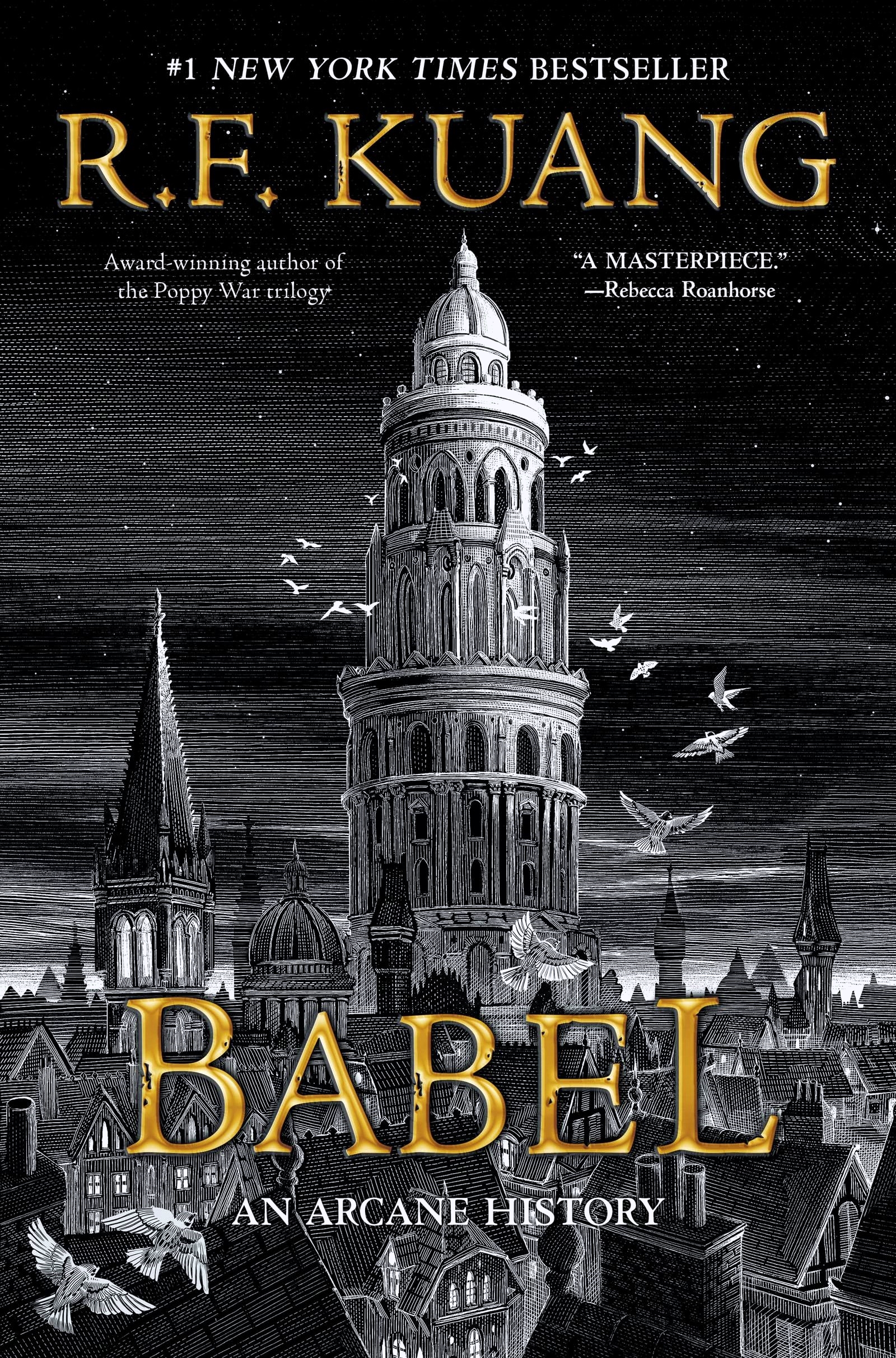
By RF Kuang
“Traduttore, traditore: An act of translation is always an act of betrayal. 1828: Robin Swift, orphaned by cholera in Canton, is brought to London by the mysterious Professor Lovell. There, he trains for years in Latin, Ancient Greek, and Chinese, all in preparation for the day he’ll enroll in Oxford University’s prestigious Royal Institute of Translation—also known as Babel. The tower and its students are the world’s center for translation and, more importantly, magic. Silver-working—the art of manifesting the meaning lost in translation using enchanted silver bars—has made the British unparalleled in power, as the arcane craft serves the Empire’s quest for colonization. For Robin, Oxford is a utopia dedicated to the pursuit of knowledge. But knowledge obeys power, and as a Chinese boy raised in Britain, Robin realizes serving Babel means betraying his motherland. As his studies progress, Robin finds himself caught between Babel and the shadowy Hermes Society, an organization dedicated to stopping imperial expansion. When Britain pursues an unjust war with China over silver and opium, Robin must decide . . . Can powerful institutions be changed from within, or does revolution always require violence?” – Goodreads
Instantly the best book I’ve read this year. What a ride. I don’t think I’ll be getting over this one for a while. I went into this with very little expectations about what it was about or how good it is. I loved Katabasis, but I’d heard a lot of different opinions on Babel. Consequently, I was thrown into this beautiful and nuanced tapestry of history, colonialism, linguistics, characters, and big existential questions. What an amazing book. So so good.
It started out relatively slow, with lots of historical exposition and in-depths explanations of Robin’s childhood education and everything he goes through. Somehow, Kuang keeps even the relentless lists of “he read this and he read that” interesting, with cutting and sneaky remarks on his situation and the state of the British Empire even early on in the book. Something amazing to me about this book was the way this expeditionary style and constant etymological explanations continued throughout the book, but the action and excitement never stopped. Once Robin gets to Oxford, the plot progresses both so slowly and so quickly at the same time. Slowly enough that you get to appreciate a classic dark-academia school life and the growth of Robin’s relationships, but quickly enough that you just have to keep turning the pages.
The magic system was so unique. I’ve been getting too used to the generic romantasy soft magic systems, so experiencing Kuang’s expertly developed silver working concept was so fun and interesting. I loved how the nature of language and translation itself informed the magic.
I’m honestly really struggling to write this review right now, I have so many thoughts and feelings and things I loved about this book… but I must keep going!
Eventually, the twists and surprises started coming so fast, one after another. The last third of the book was insane. After the first act especially, I assumed the whole book would be slow-paced and academically focused – instead, the plot went wild. Get ready for a crazy ride.
There has been a lot of discourse around R.F. Kuang’s style in the booksphere – some people love it, and some people hate it. I am firmly in the “love it” camp, but I can see where people would struggle. Kuang has a very unique voice informed by her experiences and background in academia, meaning much of the text is pumped full of random linguistic explanations, academic tangents, and even explanatory footnotes. At times, it can make the writing feel dense, but I personally felt that it never took away from the actual story. At first, it all seemed like a lot of information at once, but as you read on you get used to the thought process. It added to the immersion so much – you truly feel like you are inside Robin’s head. There’s a scene somewhere where Robin explains how much his nonstop studying at Babel is getting to him – the words and etymology fill up his head so much that he can’t get through a basic conversation without wondering where all the words came from. This phenomenon is reflected in the writing style – academic digressions expertly wax and wane with Robin’s state of mind, increasing as he frantically studies for exams and decreasing when he’s focused on other things. It creates this subconscious ebb and flow in the writing – true dark academia. I loved it.
My one complaint was with the footnotes, and this was something I recognized only after reading someone’s review that mentioned it on Substack (I’m sorry I don’t remember whose it was). Kuang mostly uses the footnotes to add context to academic mentions in the text – etymological explanations that didn’t fit in the story, backgrounds on famous academic figures (fictional and real). While some of these footnotes added relatively important information or added solid context, a lot of them seemed to be a kind of virtue-signaling recognition of some historical figure’s truly evil nature. I can’t remember an exact example, but there were plenty of times a character in the story would mention some historical abolitionist and the footnotes would be quick to clarify that though he advanced the end of slavery, he also kept slaves himself. It was as if Kuang needed to apologize for even mentioning any white men in a slightly positive light by making sure to mention all their pitfalls. Though these were true pitfalls, it gave off the same desperate vibes that a “land acknowledgement” or something does. This was probably the biggest weakness of the book – not a single white person was good. Sure, there was Letty (kind of, more on her later) and Robin’s nanny, but they got a pass because they were women. Every white man, on the other hand, even those on Robin’s side later on, are evil (those who do not always act evil only do so to protect their own selfish desires). Oppression is real. Colonialism is bad. But I think Kuang’s meticulous explanation of those ideas speaks to the postmodern lack of a moral infrastructure shared in all readers. Authors cannot depend on readers to hold the necessary moral assumptions to come to the right conclusions, so they are forced to explicitly defend a moral code within their writing instead. There is no trust in the reader to believe “colonialism is bad” unless the author defines it. Kuang chooses to do so through cancel-culture ridden footnotes.
Otherwise, I really appreciated the unapologetic academic tone and immersive style.
I’m giving this a 4.5 for the same reason I gave the “style” section a 4.5 – while I initially loved the characters, I realized after finishing the book that Kuang seems to have a very narrow archetype for white men and even women. Like I said before, there isn’t a single “good” white person. Even the white people who help Robin along the way have their own motivations, or the minority characters have to somehow “manipulate” white people into acting morally. It makes all white people out to be selfish, stupid, and driven by money and power. That conclusion is obviously simply not true and honestly takes away from the real evil that many colonialists in the British Empire supported.
Despite this, Kuang’s characterization of the main characters was extremely strong and compelling. Babel’s timeline essentially runs from the beginning of Robin’s life to the end, and in only 500 pages develops his complex and realistic character arc. Robin started out as a meek and desperate child with a personal understanding of loss and poverty. He is deeply motivated to climb the ladder in London in whatever way possible. By the end, however, he learns what some characters (one in particular) do not – personal comfort and safety sometimes needs to be given up for the good of the world. It was a truly Christian message (a shame Christianity was painted as an oppressive background foundation to the evil British Empire and seemingly only mentioned as a necessary historical base). The differences and similarities in Robin from the beginning of the book to the end add so much meaning to the book. Much of Babel asks the question, “is violence necessary for revolution?” and Robin’s life and character attempts to answer that question through the state of his emotions. I fear I am not explaining the beautiful complexity of this book well enough, but it was so impressive!
His relationships with the other main characters were so sweet and nostalgic at the beginning of the book as they all struggled through life at Oxford together. As the story progressed, they became partners in crime and representatives of a broken system and the healing it needed. Ramy, Victoire, and Letty all served as foils for Robin and representatives of their people in a myriad of ways.
Letty and her choices toward the end of the book were very interesting. She was the only white character treated with the same complexity as the main characters, but I appreciated the nuance with which her character was handled. Kuang at least tried to provide a human explanation for her actions and choices based on her own experiences as a woman.
I feel like I have so much left to say, but I’ll never finish this review. Overall, the characters were treated with a lot of care and slow progression rather than overly-speedy development. I loved Robin and his realistic flaws, and I loved his friends and their shared camaraderie.
I did not expect to be as rocked by this book as I was – twist after twist kept me cranking through all 500+ pages, and every character arc gave me an intimate and carefully-developed love for the main group. Kuang succeeded in making an incredibly complex statement on revolutionary tactics, race and class, and the nature of language and translation in one entertaining and perfect book. In many ways my eyes were opened to the horrors and ironies of British colonialism. I also gained a new appreciation for language and all the magic that comes with it. From the magic system to the main character and of course the world-changing ending, Babel is a dense and complex dark academia novel that you won’t want to miss.
Content Warnings
Violence, discussions of sexual assault, racial slurs, racism, etc. This is definitely more of an adult book that addresses complicated adult topics.
Leave a Reply
You must be logged in to post a comment.