

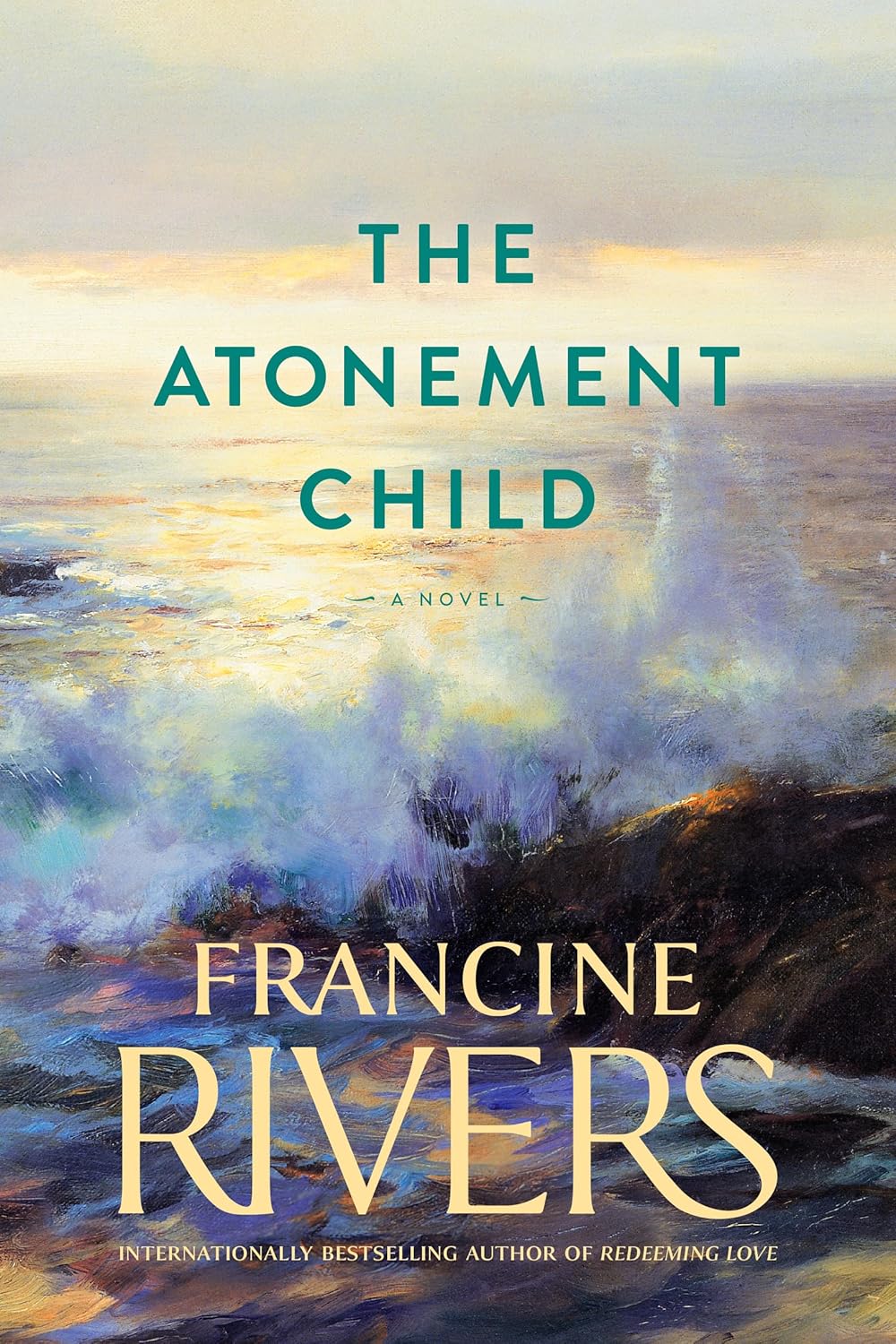
By Francine Rivers
“In one terrifying moment, Dynah Carey’s perfect life is shattered by rape, her future irrevocably altered by an unwanted pregnancy, and her doting family torn apart. Her seemingly rock-solid faith is pushed to the limits as she faces the most momentous choice of her life—to embrace or to end the untimely life within her.” – Goodreads
It’s rare that three books in a row make me excited to write a review and leave me contemplating them for days afterward – but I guess that’s the nice thing about buying books instead of picking up whatever is at the library. As a Christian reader, Francine Rivers has been recommended to me over and over. When I received The Atonement Child as a Christmas gift from a friend, I knew it was time. Let me tell you, this book was a ride. I got through the first third in one night and had to stop and rant about it to my roommate (we’ve been going to bed reading every night together – she’s also been on a book-buying kick). There were definitely some major issues with this book and Rivers hasn’t redeemed Christian fiction for me just yet, but it left me with a lot of empathy for women going through this situation. The point of reading is to open up your perspective and see life from another’s point of view. The Atonement Child made me realize how little I’ve interacted with media that truly opens me up to the horrors of rape and assault, and how necessary it is for people to understand it. While this wasn’t my favorite book ever, it definitely added nuance to my understanding of the abortion issue (in possibly the opposite direction that Rivers intended).
The pacing was all over the place. The first third was intense – Dynah’s life is almost immediately ripped into chaos, and from the first inciting event she is faced with trouble at every turn. She goes from one emotional and tough conversation/decision to the next. At about the end of this act, I was both hating the book and loving it. Hating it because of how uncomfortable it was making me and for how heavy handed and crazy the plot was getting, and loving it because sometimes we need to uncomfortable to understand the lives of other people. It woke me up to the pain and horror that can come with unexpected pregnancy after a violation.
But everything severely slowed down from there. Dynah goes home and spends the rest of the book wavering in whether she wants to keep the baby or not (even though at this point you kind of know she’s keeping it) and arguing with various people about it. She makes crazy choices that only an upper-middle-class white girl could make and progresses through her pregnancy. It became less intense and more frustrating. The whole last two acts I was so confused why all of the Christians in her life (except for the love interest) wanted her to have an abortion. It was ridiculous and unrealistic. Sure, maybe a few, but definitely not all of them.
The first act was what really hooked me, though. Dynah’s crisis taught me that abortion in cases of rape is not as simple as it seems. I still see all abortion as murder and would never advocate for punishing a baby for the sins of a rapist, but I see how conflicting the issue is for an unexpectedly expecting mother. Rivers gave me so much empathy for those women, even though the intent of the book was to show that abortion should never be the solution even in the case of rape.
River’s style might have been my biggest problem with the book. The Atonement Child discusses extremely emotional situations like sexual assault, pregnancy, questioning of faith, and abortion – but it does so in this uncomfortable, detached tone. It seems like Rivers is trying to communicate emotion, but she never learned the “show, don’t tell” principle. If a character is sad, the book just says “she was sad,” instead of, I dunno, “her eyes welled up with tears” or something. You know what I mean? Even as I gained the perspective of a woman facing such a tough situation, I felt removed and disgusted by the tone. It was just too “narrated” for me.
The other style issue was the heavy handed, preachy attitude present in a lot of Christian fiction. I would love to be able to read more books that communicate Christian values and ideas, but so far C.S. Lewis is still the only good example I can think of. Most other Christian authors don’t trust the reader to work out the spiritual themes on their own, so they shoehorn them in too obviously to give the reader that satisfying “oh, I get it” moment. As image bearers of God doing everything for His glory, we are to do everything with excellence. Unfortunately, a lot of Christian fiction is more focused on preaching than being excellent. Rivers is a great example of this. The anti-abortion narrative is forced in in harmful ways. Dynah’s pregnancy and rape is almost treated as the result of a curse for generational sins (other women in her family had abortions), and while this may have been a misunderstanding by characters, it’s never outright refuted by the author. Though other characters are “forgiven” for other abortion-related sins (and don’t get me started on the way that happens – in one case Dynah acts as some kind of mouthpiece for God to forgive an abortion doctor) it makes it seem as though God enacted judgement on a whole family for abortions of the past, which brings to bear so many theological questions and issues that at least need to be discussed so non-Christian readers don’t think God causes rape as revenge for sin. There are just a ton of ways Rivers is too heavy handed with her message.
The faith narrative is also kind of harmful. For one, almost every Christian character is a-okay with Dynah getting an abortion, in fact, they either pressure her into it or tell her to “pray for a miscarriage,” which is disgusting. I understand not every Christian is a good Christian, but there were just unrealistic amounts of hypocrisy going on at this majorly Christian college she was attending. It made being anti-abortion seem like a rare thing even in Christian circles, which is extremely incorrect.
Rivers also does this thing where every once in a while, “God” will speak in the form of all caps letters? I’m unsure if this is just the characters remembering out-of-context Bible verses at exactly the right times or if it’s portraying God speaking through the Holy Spirit, but it made me kind of uncomfortable. I don’t like seeing authors write God in as a “character” without Him speaking being actual verses. Also, everyone was constantly praying. In the same voice. Like, the characters would have slightly different voices and tones in their dialogue, but then when it portrayed them speaking, they all sounded like they were reciting guided prayers in devotional books. When I pray in my head, I talk to God. I don’t shift to 1950s proper English.
Dynah helped me see the perspective of a woman going through an unexpected pregnancy, but I also had no idea who she was as a person. It kind of helped to be able to see Dynah as a relatable, cookie-cutter girl who could be anyone, but it didn’t make for a very exciting or lovable character especially once the action slows down. Dynah seems to have no hobbies, flaws, or talents other than “volunteering at a soup kitchen”, “being a Christian and constantly praying”, and “making crazy spur-of-the-moment decisions that come out of nowhere because the author rarely gives the reader a good look into her thoughts and we never understand her true motivations because she has no three-dimensionality.” I can’t even tell you what Dynah was studying at college other than “getting a husband.”
This applies for the rest of the characters as well. What did Dynah’s dad even do for work? Why is Ethan such a meanie-head? How did Dynah become friends with her roommate? I knew nothing about the characters other than their reactions to Dynah’s pregnancy. The cast actually grew so much by the end of the book – I guess Rivers wanted to show the positive effect Dynah would have on so many people because of her faithfulness – but I could barely keep them straight because they all had the same personality. Again, this added to the “preachy” attitude of the book. Everyone was just there as a foil for Dynah’s perfect faithfulness.
The Atonement Child was not a great book. The pacing was off, the characters had no background or personalities, the tone was preachy and heavy handed… but I feel I actually gained a lot from reading it. There are a lot of ways Rivers could have crafted a more effective, hopeful, and convincing novel, but it still succeeded in revealing to me the perspective of a woman in crisis that I had not experienced before. It gave me a lot of empathy and understanding despite my problems with the book itself. If you’ve enjoyed Rivers’ other books or you don’t mind a technically flawed book with a good message, I would recommend. Just don’t go into expecting a nuanced plotline or perfect theological accuracy.
Content Warnings
A woman is violently raped and assaulted. The moment is not described, it basically says “he grabbed her” then fades to black, but it is extremely horrible to imagine. It left me feeling violated just imagining it. The assault results in a pregnancy, and the main character is encouraged to and almost has an abortion. It is full of tough adult topics – this one’s definitely better for older readers.
Leave a Reply
You must be logged in to post a comment.